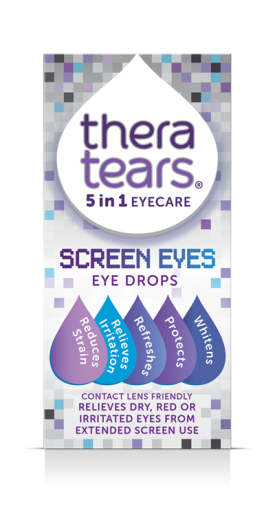
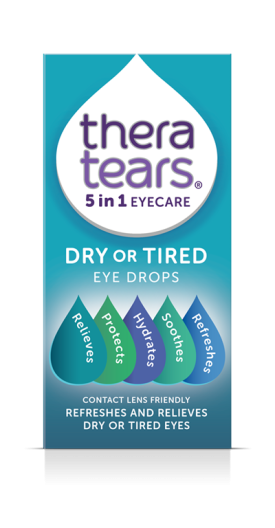
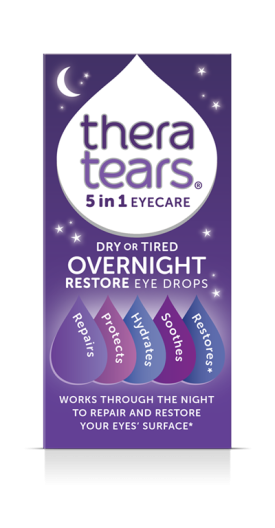
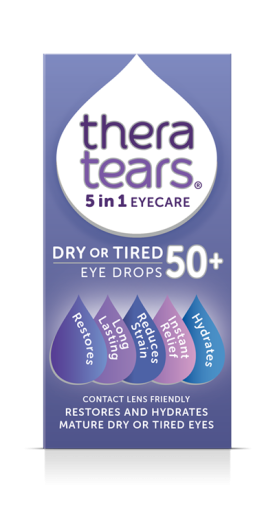
For relief from dry, tired or irritated eyes, choose TheraTears®. Our innovative 5 in 1 drops take the guesswork out of finding the right solution for your eyes. All containing hyaluronic acid, a natural and trusted ingredient for eye lubrication, our drops deliver 5 clear benefits based on your needs.
5 in 1 eye drops that soothe, rehydrate and revitalise
With so many eye drops on the market claiming to do a variety of different things, it can be difficult to know which ones to pick. TheraTears® solves this problem. Our drops are specially formulated to deliver 5 clear benefits in each pack to provide instant relief.
TheraTears® eye drops provide relief for Dry, Tired, Itchy, Red orIrritated eyes with a range of specially formulated drops that are designed to soothe, rehydrate and revitalise.
Browse our range to select your one stop eye drop today. You can take your pick from our Dry or Tired, Dry or Tired 50+, Dry or Tired Overnight Restore and Screen Eyes products.
All products in our range contain hyaluronic acid or cross-linked hyaluronic acid to replenish and retain moisture, keeping your eyes lubricated. They also feature naturally derived ingredients and are preservative-free, or contain a gentle preservative that breaks down as soon as it touches your eye – meaning the drops are preservative-free on your eye. What’s more, all of our products are suitable for use with contact lenses.
I am slide content. Click edit button to change this text. Lorem ipsum dolor sit amet, consectetur adipiscing elit. Ut elit tellus, luctus nec ullamcorper mattis, pulvinar dapibus leo.
I am slide content. Click edit button to change this text. Lorem ipsum dolor sit amet, consectetur adipiscing elit. Ut elit tellus, luctus nec ullamcorper mattis, pulvinar dapibus leo.
I am slide content. Click edit button to change this text. Lorem ipsum dolor sit amet, consectetur adipiscing elit. Ut elit tellus, luctus nec ullamcorper mattis, pulvinar dapibus leo.
I am slide content. Click edit button to change this text. Lorem ipsum dolor sit amet, consectetur adipiscing elit. Ut elit tellus, luctus nec ullamcorper mattis, pulvinar dapibus leo.
I am slide content. Click edit button to change this text. Lorem ipsum dolor sit amet, consectetur adipiscing elit. Ut elit tellus, luctus nec ullamcorper mattis, pulvinar dapibus leo.